

AI concept emergence
Artificial Intelligence concepts have been around for decades dating back to 1956, but they really started becoming a key talking point in the future of tech in 2020, following crucial breakthroughs in neural-network designs that changed the dynamics of how AI can be integrated into commerce and economic systems. In recent months, these concepts have exploded into the market following the introduction of large language AI models like Dal-E and Chat G.P.T, which reached 100 million active users in just two months. This was the starting point of the recent hype creation around the potential of AI.
This hype has now been labeled as the “AI arms race,” leading to the rise of a new grouping of mega-cap tech stocks known as the ‘Magnificent 7’. These seven tech stocks now have a combined market cap of $11,34 trillion US dollars (as of 14/07/2023) and account for +/- 30% of the total S&P500 in terms of market cap.
The Magnificent 7:
To put this into context, just looking at the largest of the seven, Apple, they have a market cap of $3 trillion US dollars which is larger than Frances’s total GDP ($2.78 trillion in 2022) and more than seven times that of South Africa ($406 billion in 2022). If we include the other six into the fold, which are Microsoft, Alphabet, Amazon, Meta, Nvidia, and Tesla, cumulatively, they are 3.5 times larger than the entire GDP of the African continent and have an equivalent market cap of 66% of the European Union GDP (16.64 trillion as of 2022).
Due to these seven companies’ size, they play a substantial role in global market returns and movements, which are heavily concentrated around their performance. On the back of coming from a very risk-off year last year and this new AI hype, these companies are shooting lights out this year in terms of their share price performance.
Stock Year-to-Date Performance and Market Caps below as of 14/07/23:
| Company | Stock Performance | Market Cap (Trillion USD) |
| Alphabet | 42% | 1,60 |
| Microsoft | 44% | 2,57 |
| Apple | 52% | 3,00 |
| Amazon | 57% | 1,38 |
| Tesla | 160% | 0,88 |
| Meta | 148% | 0,79 |
| Nvidia | 218% | 1,12 |
| 11,34 |
By comparison, the S&P500 index was up 16% as of June 2023, but if we apply an equal-weighted version of this index, we see that it would have returned less than 5% over the same period.
Now if we strip out the so-called Magnificent 7 from the S&P500 and only look at the remaining 493 companies, we see that it would only be up 6%.
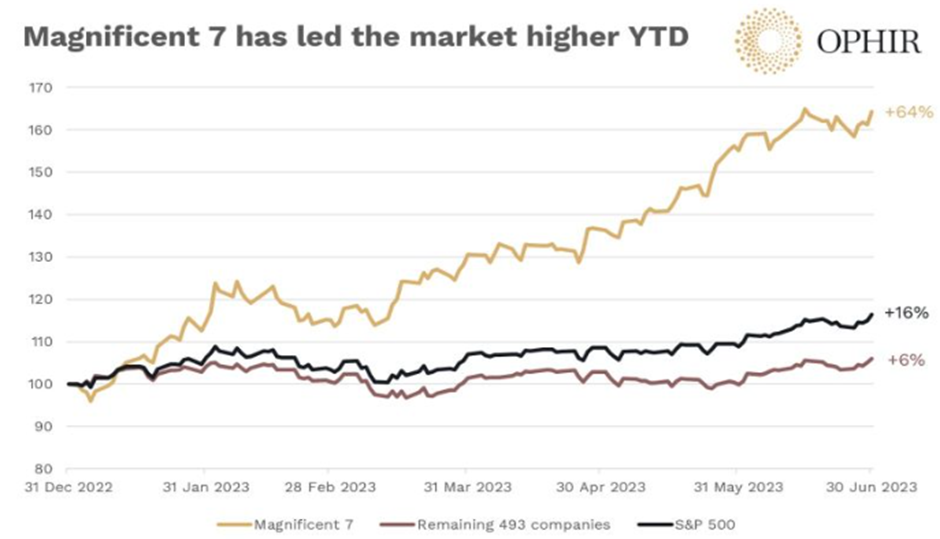
Further, if we strip out all AI-related names, including those not in the ‘Magnificent 7 we see that the S&P500 would be in negative territory.
It’s evident that these seven stocks are playing a major role in lifting the US and global Indices. However, one must be cautious of market concentration risk, as the share surge in AI-linked companies has created fears of a new financial bubble. Additionally, 4 of the 7 stocks fall into the top 25 worst-performing stocks in the S&P500 for 2022, with Tesla (-65% in 2022), Amazon (-50% in 2022), and Alphabet (-39% in 2022) yet to reach the same price they were at the end of 2021 despite their surge this year.
Bubble or next industrial revolution?
So far, only a handful of stocks have benefited from the AI hype, and the underlying market has remained subdued. This is similar to the early stages of the tech mania in the 90s when the Four Horsemen (Microsoft, Intel, Cisco Systems, and Dell) led the internet boom, but large financial institutes like Morgan Stanly believe that AI will accelerate digital transformation and has the potential to create a further $6 trillion Dollar investment opportunity this year alone. Their outlook aligns with many other market participants who believe that these AI concepts are a breakthrough moment that will revolutionize everything from online search to commerce and that the introduction of these AI models will create a global productivity boom that we’ve only seen a few times in the past 75 years.
A special report released by Alpine Macro notes that AI needs significant volumes of data to be useful/accurate. “This could limit how many AI players dominate the supply side because benefits only accrue to the largest data aggregators. This means that large-platform or network companies are better positioned to adopt, provide, and profit from AI. These include the likes of Meta, Apple, Google, Tencent, and Alibaba, to name a few”. (Alpine Macro, 2023).
However, it should be noted that most investment experts are not questioning the potential of AI but rather if its linked share price valuations have stretched too far.
The question is – Are we in an AI bubble like in the late 90s, or will AI revolutionize everything?